If you owned an iPad in the mid-2010s, you may remember a curious option buried in the cellular settings: Apple SIM. It promised to free you from plastic SIM cards, letting you hop between carriers and data plans without visiting a store or waiting for a nano-SIM in the mail. The idea was elegant — but in Russia, it never really got off the ground. Here is how Apple SIM worked, why it stalled in Russia, and what replaced it.
What Apple SIM actually was
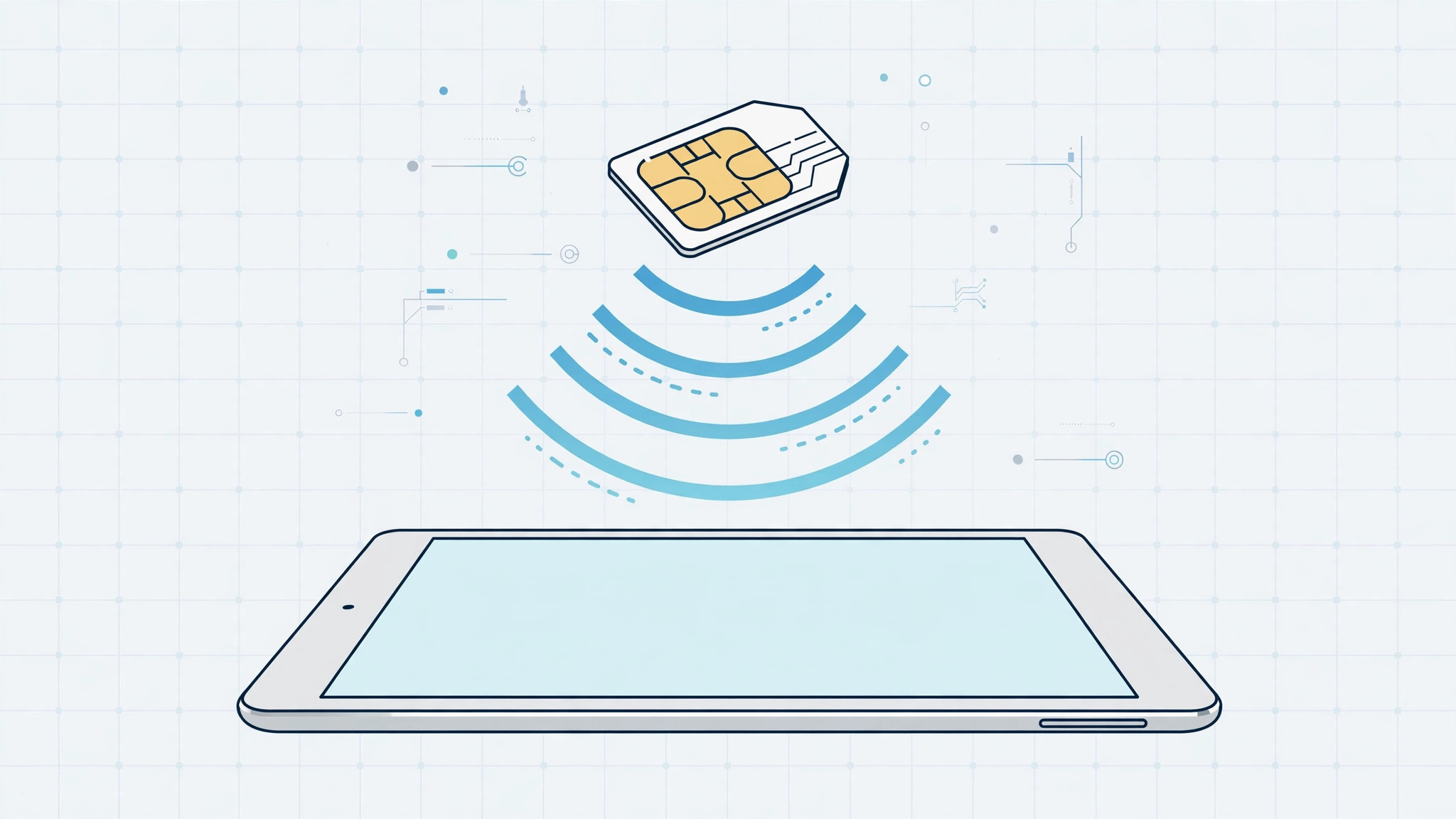
Apple SIM was a reusable SIM card that was not locked to any single carrier. Instead of physically swapping cards when you changed operators, you opened Settings on your iPad and picked a carrier and data plan right on the screen. Apple introduced it in 2014 with the iPad Air 2 and iPad mini 3; later iPad models shipped with Apple SIM embedded as a module inside the device, so there was nothing to insert at all.
The concept was aimed squarely at tablets and data plans. A traveler could land in a new country, open Settings, and sign up for a local carrier’s plan on the spot. On paper it worked in more than 90 countries — but with an important catch: only a limited list of partner carriers in each country actually supported it. Apple’s own support article on Apple SIM listed which operators took part.
How it worked in Russia
Apple SIM reached Russia only in late 2015, more than a year after its debut — and it arrived with a problem. No Russian carrier ever signed an agreement with Apple, so the feature could only lean on two foreign operators.
The first was AlwaysOnline Wireless, available from December 2015 — but its plans were sold to foreign tourists visiting Russia, not to Russian citizens. The second was GigSky, which had no regional restrictions but charged Russia tariffs so high they made little sense next to a cheap local SIM. MacRumors covered the slow trickle of carrier partnerships at the time.
The bottom line: Apple SIM functioned on a technical level in Russia, but it offered no real benefit. Part of the friction was regulatory — Russia’s strict rules around verifying SIM cards and identifying subscribers never meshed well with a system designed to let you sign up for a plan in a few taps.
Why it never took off
Apple SIM needed carriers to play along, and most preferred selling their own contracts. With no domestic partners, high prices, and only a handful of supported iPad models, the feature stayed a curiosity rather than a reason to buy. Apple quietly wound it down and ended new Apple SIM activations in 2022, as 9to5Mac noted at the time — part of Apple’s broader move away from physical SIM cards altogether.
The modern replacement: eSIM
The idea behind Apple SIM did not die — it evolved into eSIM, which is now built into iPhones and iPads and supported by carriers worldwide. If you want the same carrier-hopping convenience today, eSIM is the way: Apple’s eSIM support guide walks through the setup. And if you juggle several lines, iOS even lets you allow calls only from a specific SIM in Focus mode.

If it still doesn’t work
If you have an old iPad with an Apple SIM and cannot get online, do not spend long troubleshooting — the service is discontinued and no new activations are possible. Remove the Apple SIM profile, insert a regular nano-SIM from a local carrier, or switch to eSIM if your iPad supports it.
Frequently asked questions
Can I still activate Apple SIM today?
No. Apple ended new Apple SIM activations in 2022, and partner carriers have shut down their Apple SIM plans. The hardware still exists in old iPads, but it can no longer get you a working data plan.
What should I use instead of Apple SIM on an iPad?
Use eSIM if your iPad supports it — most cellular iPads from recent years do — or a regular nano-SIM from a local carrier. Both offer far more plan choices than Apple SIM ever did in Russia.
Conclusion
Apple SIM was a clever idea that arrived in Russia too late, with too few partners and prices too high to matter. Its legacy lives on in eSIM, which finally delivers on the original promise: change carriers from your Settings screen, no plastic required.